


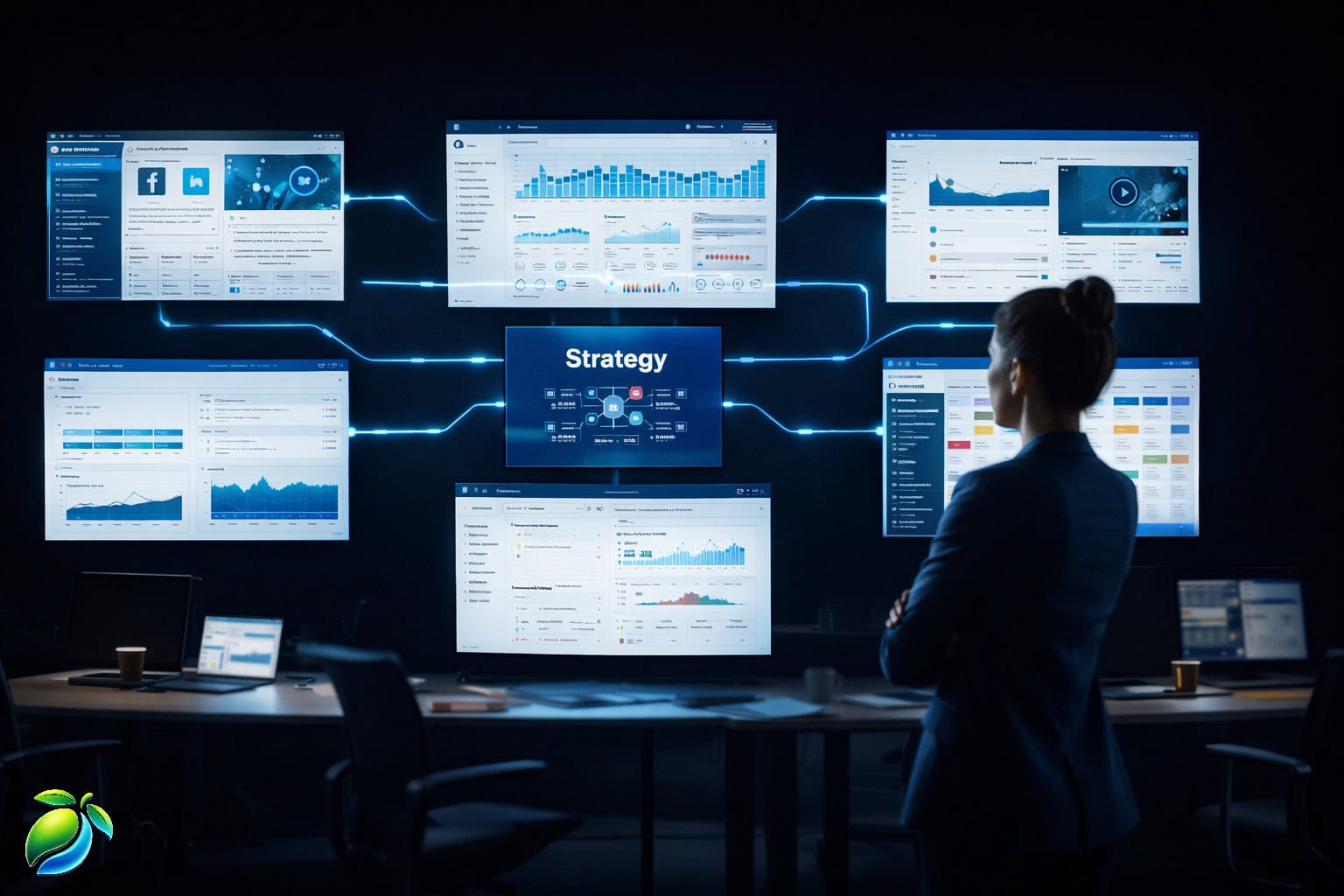
Most businesses are doing digital marketing. Very few are doing it well, and the gap between the two is almost always the same: they treat it as a collection of separate tools rather than a single connected system. Digital marketing is the use of online channels, content, and data to attract the right audience, build trust, and convert attention into revenue. It works when strategy comes first and channels serve it. It fails when channels are chosen before anyone has asked what the business actually needs to achieve.
This is a more important distinction than it sounds.
The Business That Does “Everything” but Gets Nothing
We see this pattern constantly. A business has a website. It runs occasional Google Ads. Someone is posting on LinkedIn twice a week. There is an email newsletter that goes out when someone remembers. Each piece looks reasonable on its own. But nothing is connected to anything else. The ads send people to a homepage that does not convert. The LinkedIn posts have no clear call to action. The newsletter has no link to the blog. The blog has not been updated in three months.
This is not a digital marketing strategy. It is a collection of activities that feel like marketing without functioning as marketing. The difference is not about budget or effort. It is about whether the pieces work together toward a shared outcome.
Digital marketing, done correctly, is a system. Every channel has a role. Every piece of content serves a purpose. Every euro spent is accountable to a result. The businesses that grow through digital marketing understand this. The ones that don’t keep switching tools, blaming agencies, and wondering why nothing seems to work.
What Digital Marketing Actually Covers
The term covers more ground than most people realize, which is part of why it gets handled so loosely. A complete digital marketing system includes several distinct disciplines, each with its own rules and its own contribution to the whole.
- Search engine optimization (SEO).
SEO means making your business visible when people search for what you offer. This includes the technical health of your website, the quality of your content, and the authority your site builds over time. According to HubSpot’s State of Marketing Report 2026, website, blog, and SEO is the single highest ROI-generating channel for B2B brands. That is not a coincidence. It is because SEO attracts people who are actively looking for what you sell, which makes them far easier to convert than cold audiences. - Content marketing.
This is the fuel that makes SEO, social media, and email marketing work. Blog articles, case stories, white papers, videos, and podcasts all serve one purpose: to demonstrate that your business knows what it is doing. Content marketing generates three times more leads than outbound marketing at 62% less cost. That figure has remained consistent for years because the logic behind it does not change. People buy from businesses they trust. Content builds trust before a conversation ever happens. - Social media.
Social media is not just a place to post. It is where your audience forms opinions about whether your business is credible, active, and worth knowing. Different platforms serve different purposes. LinkedIn is the primary channel for B2B credibility and executive visibility. Instagram and Facebook serve relationship-building and awareness. The mistake is treating social media as a broadcast channel rather than a trust channel. - Email marketing.
Email is the most direct line to an audience that has already expressed interest. It does not depend on algorithms or ad spend. It goes to people who asked to hear from you. For B2B audiences specifically, email remains one of the most reliable channels for nurturing prospects through a longer buying process. - Paid advertising.
Google Ads and paid social give you visibility on demand. They work best as amplifiers of what is already working organically, not as a substitute for strategy. A business with no clear message and no converting website will waste money on ads. A business with both of those things can use paid advertising to accelerate what is already working. - Video.
Short-form video is now the highest ROI content format, with 49% of marketers naming it their top-performing format according to HubSpot’s 2026 research. This is not a trend. Video is now a foundational channel, not an optional extra.
These channels do not work in isolation. A blog article improves SEO, gives you something to share on social media, feeds your email newsletter, and provides material for video content. When you see it this way, digital marketing is not six separate things. It is one engine with six moving parts.
Strategy Comes Before Channels. Always.
The most common mistake we see is businesses choosing channels before defining what they want to achieve. They open an Instagram account because a competitor has one. They run Google Ads because someone read that they work. They start a LinkedIn company page because it seems professional. None of these decisions are wrong. They are just made in the wrong order.
A digital marketing strategy starts with three questions. Who are you trying to reach? What do you want them to do? Where do they spend their time online? The answers determine which channels matter and which do not. A Belgian B2B company selling industrial services to procurement managers does not need TikTok. It needs excellent SEO, a strong LinkedIn presence, and a content strategy that answers the questions its buyers are actually asking. A local restaurant needs Google presence, strong photography, and Instagram. The channels are completely different because the audiences are completely different.
Without strategy, digital marketing becomes reactive. You post when someone reminds you. You run an ad when sales slow down. You redesign the website when it looks dated. The problem is that reactive marketing never builds momentum. It produces spikes and gaps, not growth.
Consistent, strategic digital marketing compounds over time. The businesses that understand this outperform the ones that only show up when they feel they need to.
The Part Most Businesses Are Missing in 2026
Something significant has changed in how buyers find businesses online, and it is happening faster than most marketing plans have caught up with.
For most of the past decade, digital visibility meant ranking on Google. That is still important. But it is no longer the whole picture. Gartner projects that traditional search volume will decline by 25% by the end of 2026 as more buyers use AI tools to find answers, compare options, and make decisions. Platforms like ChatGPT, Perplexity, and Google’s AI Overviews are now giving buyers answers directly, without requiring them to click through to a website.
This creates a new challenge and a new opportunity. If your business is not structured to appear in AI-generated answers, you are becoming invisible to a growing segment of buyers, even if your website ranks well on traditional Google search. The discipline that addresses this is Large Language Model Optimization (LLMO), which means structuring your content so that AI systems can understand, trust, and cite your business. This is now part of what a complete digital marketing system must include.
The businesses that invest in both SEO and LLMO will be visible in every environment where buyers are searching. The ones that focus only on traditional SEO are building for a landscape that is already changing beneath them.
Measurement Is Not Optional
Digital marketing’s greatest advantage over traditional marketing is also its most neglected feature: everything can be measured. You can see exactly how many people visited your website, where they came from, how long they stayed, and what they did next. You can track which social posts drove traffic, which emails converted, and which ad audiences responded. This data exists whether you look at it or not.
Most businesses do not look at it seriously. They check vanity metrics, like follower counts and likes, and assume things are working if the numbers go up. But follower counts do not pay salaries. The metrics that matter are the ones connected to business outcomes: leads generated, conversion rates, cost per acquisition, and return on investment.
We work with businesses that have been running digital marketing for years and cannot tell you what it has produced commercially. That is not a tool problem. It is a culture problem. Digital marketing without measurement is just spending money and hoping. Measurement is what turns spending into investment.
Frequently Asked Questions
- What is the difference between digital marketing and traditional marketing?
Traditional marketing uses offline channels like print, radio, billboards, and direct mail. Digital marketing uses online channels including search engines, social media, email, and websites. The practical difference is measurability and targeting. Digital marketing lets you know exactly who saw your message, whether they responded, and what it cost per result. Traditional marketing cannot match that level of accountability. - Which digital marketing channel gives the best return on investment for B2B companies?
For B2B businesses, website and blog content combined with SEO consistently delivers the highest long-term ROI. HubSpot’s State of Marketing Report 2026 identifies this as the top ROI channel for B2B brands. Email marketing is also very strong for nurturing existing prospects. LinkedIn is the leading social channel for B2B, particularly for building executive visibility and generating qualified leads. - How long does it take to see results from digital marketing?
Paid advertising can produce results within days. SEO and content marketing typically take three to six months to show meaningful results, and compound significantly over time. Email marketing produces results in line with your existing list size. The businesses that give up on digital marketing before six months almost always quit before the investment has had time to perform. - Does my small Belgian business really need digital marketing?
Yes. Size is not the relevant factor. Your buyers are online, which means your visibility online determines whether they find you or your competitor. Digital marketing allows small businesses to compete with larger ones by being more targeted and more consistent, even with modest budgets. The businesses that grow are the ones that treat digital marketing as an ongoing investment, not an occasional expense. - What should come first in a digital marketing plan?
Strategy always comes before channels. Before choosing any platform or tool, define who you are trying to reach, what you want them to do, and what problems you are solving for them. Without this foundation, any channel you choose will underperform because the message will not be clear enough to convert.
Build a Digital Marketing System That Actually Works
Digital marketing does not fail because the tools are wrong. It fails because the pieces are not connected, the strategy is missing, or the measurement stops at likes and follower counts. The businesses that build a connected system, with the right channels serving a clear strategy and every result tracked, are the ones that grow consistently.
BluMango helps businesses build digital marketing systems that function as a whole: strategy first, the right channels for the right audience, and content structured for both Google search and AI-generated answers. If your digital marketing feels like a collection of disconnected activities, reach out to our team through Contact Us and let’s look at where the gaps are.
About BluMango
BluMango is a full-service marketing agency based in Belgium, built for businesses that want to grow with smart strategy, powerful content, and modern visibility. We offer a wide range of services including marketing advisory, content creation, social media management, SEO, website design, and more. If you need clarity, creativity, and consistency in your marketing, our team is here to help. 👉 View the full overview on our Services page.


